
If you search for medication reminder apps, you will find dozens of options. Most of them are built around the same basic idea: tell the app what pills you take and when, and it will send you a notification. For a single person with a simple daily schedule, that is probably enough. But for a lot of people, it falls far short.
Here is what actually matters when choosing a medication reminder app, and how to find the right one for your situation.
What makes a good medication reminder app
The basics are table stakes: set a medication, set a time, get a reminder. Every app on the market does this. The differences that matter are in the details.
Flexibility for complex schedules. Real medication schedules are not always "once a day." They include every other day, three times a week, weekly injections, tapering doses after surgery, medications taken with food and others taken on an empty stomach, medications that cycle on and off. An app that can only handle simple daily reminders will fail you the moment your schedule gets complicated.
Logging and history. A reminder is only half the job. You also need to be able to log whether you actually took the medication, and see a history of what was taken and when. This is especially important for medications where you might not remember if you took a dose an hour ago, and for sharing with a doctor who wants to see adherence over time.
Supply tracking. Running out of a critical medication is stressful and avoidable. A good app lets you track how many doses you have remaining and reminds you to refill before you run out.
Reliability. Notifications that do not arrive are worse than no system at all. They create false confidence. The app you choose needs to work consistently, even after a phone restart or an OS update.
Different situations need different things
There is no single best medication reminder app for everyone. The right choice depends on your situation.
For individuals with simple schedules, almost any basic reminder app will work. The main thing to look for is reliability and ease of use. If adding a medication takes more than two minutes, you are less likely to actually set it up.
For individuals with complex schedules, you need an app built to handle unusual timing, multiple medications with different rules, and the ability to log doses accurately. A lot of the simple apps break down here.
For families and households, the single biggest requirement is shared access. If you and your partner both need to know whether a dose was taken, or if you are managing medications for a child with a fever, an aging parent, or a family member with dementia, or coordinating care among siblings, you need an app where multiple people can see the same information in real time. An app built for one person will not serve a household.
For caregivers, shared access matters even more, and you also need the ability to manage medications for someone else without it getting confused with your own. The app should handle multiple household members cleanly, with clear separation between each person's medications. If the situation involves an elderly parent specifically, medication reminders for the elderly compares reminder apps against the other system types (dispensers, manual organizers, shared logs) that often matter more than the app alone.
For pet owners, most medication apps do not account for pets at all. If your dog is on a daily medication or your cat is finishing a course of antibiotics, you need an app that treats pets as household members the same way it treats people.
What to avoid
Apps that require a subscription just to add a second person. If you live with anyone and need to share medication information, you should not be locked out of the feature that matters most.
Apps with cluttered interfaces. Medication management is already stressful. An app that is hard to navigate adds to that stress rather than reducing it. Simple and calm wins every time.
Apps that have not been updated recently. Notification behavior on iOS and Android changes with every OS release. An app that has not been maintained recently may stop working reliably after an update.
Apps that are actually trying to sell you something else. Some "medication reminder" apps are primarily platforms for pharmacy partnerships, supplement advertising, or medication delivery services. Your medication history should not be a data source for advertisers.
The best option for households and caregivers
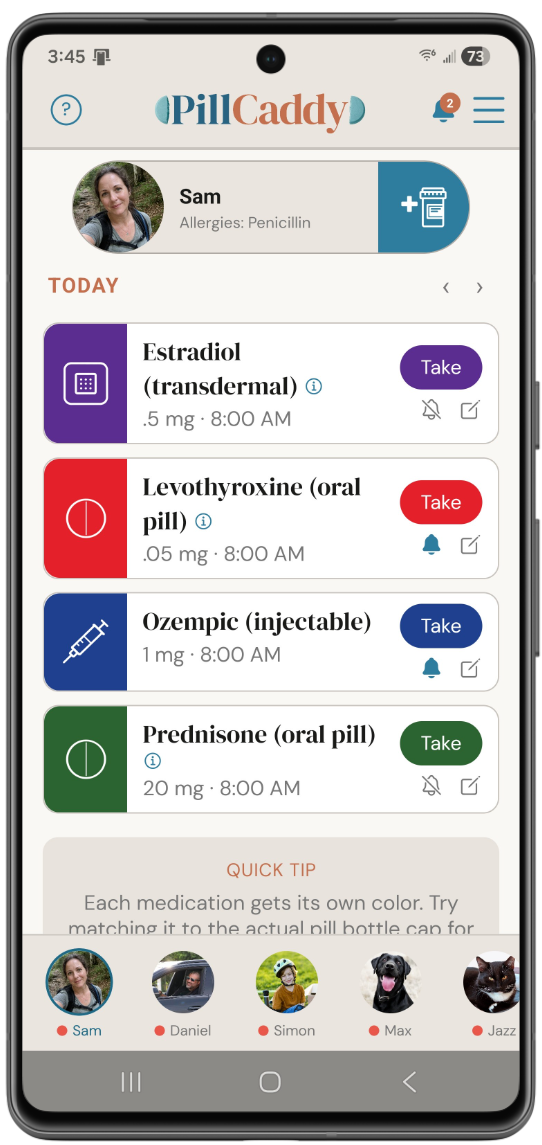
For anyone managing medications for more than one person, or coordinating care with another person, PillCaddy is the strongest option available in 2026. It is built from the ground up for households: multiple members, shared real-time access, and support for complex schedules that other apps cannot handle.
Every household member, people and pets alike, is tracked in one place. When one person logs a dose, everyone with access sees it immediately. Reminders go to the right people. Supply tracking keeps refills from sneaking up on you. And the AI-powered schedule builder handles the unusual schedules that stump other apps.
For individuals with simple needs, a basic reminder app may be all you need. But if your household is managing multiple people, aging parents, a pet on medication, or any schedule that does not fit in a basic daily format, PillCaddy is worth a look.

Built for households, not just one person
PillCaddy is designed for households where more than one person is responsible for medications: multiple members, shared real-time logging, and schedules that go beyond once-a-day reminders. Everyone with access sees the same record and can log doses from their phone. The Essentials tier is free.
Frequently asked questions
What should I look for in a medication reminder app?
The basics of setting a medication and getting a notification are table stakes, so the real differences are in flexibility for complex schedules, dose logging and history, supply tracking, and reliability after phone restarts and OS updates. Which of these matters most depends on your situation. A household with several people has very different needs from a single user.
What is the best medication reminder app for families and households?
For managing medications across more than one person, the single biggest requirement is shared access so everyone sees the same record in real time. PillCaddy is built from the ground up for households, with multiple members, shared logging, and support for complex schedules. An app built for one person rarely serves a household well.
Are free medication reminder apps good enough?
For an individual with a simple daily schedule, a basic free app is often all you need, and reliability and ease of use matter more than extra features. The gaps usually show up around shared access and complex schedules. It is worth avoiding apps that lock the ability to add a second person behind a subscription if sharing is what you need.
Can I use one app to track medications for my whole family and pets?
Yes, though most apps do not account for pets at all. PillCaddy tracks every household member, people and pets alike, in one place, so a dog on a daily medication or a cat finishing a course sits alongside the rest of the family. When one person logs a dose, everyone with access sees it.
Why do my medication reminders sometimes stop working?
Notification behavior on iOS and Android changes with most OS releases, so an app that is not maintained can quietly stop firing reminders after an update. Missed notifications are worse than no system because they create false confidence. Choosing an app that is updated regularly reduces this risk.
Are medication reminder apps safe with my private health data?
Some apps that present as reminder tools are primarily platforms for pharmacy partnerships or advertising, so it is worth checking how an app uses your information. Your medication history should not be a data source for advertisers. Reviewing the privacy policy before committing is a reasonable step.