
If you're reading this, there's a good chance you're not the only person helping manage your parent's medications. Maybe you and a sibling are splitting the daily work. Maybe a sibling lives far away and handles insurance and refills from a distance. Maybe your parent has a home aide who comes a few days a week. Maybe you've got a spouse helping out, or grandchildren who stop by, or a neighbor who looks in when nobody else can. The exact configuration varies, but the fact pattern is the same: there's more than one person involved in keeping your parent's medication schedule on track, and that creates a coordination problem that's separate from the medication problem itself.
This article is about that coordination problem. Not the clinical question of which medications your parent takes, or which schedule is right; those decisions live with your parent's doctors and pharmacist. The question here is how a group of family caregivers, possibly with a professional aide involved, can stay aligned on what's been given, what hasn't, who's responsible for what, and how to avoid the specific mistakes that happen when more than one person is managing someone else's medications.
A note before we start: this gets emotional quickly. Sibling dynamics around aging parents are some of the most loaded territory in adult family life. The advice below is technical and practical, but the actual work of doing this well is at least as much about the relationships as it is about the systems. Both matter; we'll cover both.
Why multi-caregiver medication management is its own problem
Single-caregiver medication management is hard. Multi-caregiver medication management is harder, and the reasons are specific. Three things go wrong that don't go wrong when one person is in charge.
The duplicate dose risk. This is the failure mode every multi-caregiver family eventually faces. One sibling visits in the morning and gives the morning medications. A different family member stops by at lunch, asks the parent if they took their pills, gets an uncertain answer, and gives them again. The parent ends up with double doses of everything. Depending on what they're taking, that can range from inconvenient to genuinely dangerous. It is one of the most common failure points in shared family caregiving; the Family Caregiver Alliance's guide to medications and aging covers the broader medication risks that caregivers face. The fix isn't more careful family members; the fix is a shared, real-time record that any caregiver can check before administering a dose.
The dropped dose risk. The opposite problem. Everyone assumes someone else took care of it. The morning sibling thought the evening sibling would handle the night meds. The aide thought the daughter was coming by. The result is a missed dose that nobody knows about, and the next person to check the pill organizer sees an empty Tuesday compartment and assumes the medication was taken when it wasn't. Without active confirmation that a dose was administered, "the compartment is empty" tells you nothing useful.
The communication tax. Even when nothing actually goes wrong, multi-caregiver families spend an enormous amount of time texting and calling each other about routine medication questions. "Did you give Mom her morning pills?" "Are we picking up the refill today or tomorrow?" "Does she still take the blood thinner or did the doctor stop it?" This invisible coordination work is one of the most exhausting parts of family caregiving, and it builds resentment over time, even when everyone is acting in good faith.
The three problems share a single underlying cause: there's no shared source of truth that everyone trusts. Solve that, and most of the rest of the coordination problem resolves itself.
The conversation that has to happen first
Before any system can work, the family needs to be on the same page about how the medication work will be divided. This conversation is often skipped because it feels awkward or unnecessary, especially if the situation evolved gradually. But skipping it almost always means the wrong person feels the wrong amount of burden and the resentment builds quietly.
A few principles that make this conversation easier:
Be specific about responsibilities, not vague about "helping." "Everyone helps with Mom" is the formulation that produces nothing. "Sarah manages the medication list and pharmacy coordination. Mark handles the morning and evening doses on his visit days. Their brother coordinates appointments and prescription refills from out of state." That's a formulation that actually works. AARP's guidance on sibling caregiving makes the same point: assign each person a specific role, and the coordination problems that come with vague "everyone helps" arrangements largely resolve.
Acknowledge the geographic asymmetry honestly. Long-distance siblings often feel guilty about not being able to do hands-on work. On-site siblings often feel resentful about carrying all the daily burden. Both feelings are real. The fix isn't to pretend they're equal contributions; it's to name them as different contributions and divide work in a way that lets long-distance family members carry some of the weight that doesn't require proximity: insurance navigation, pharmacy coordination, doctor's appointments by phone, financial management, and the family-coordination role itself.
Designate a primary medication manager. Even with multiple caregivers, one person should own the overall medication picture: the current list, the schedule, the relationship with the doctor and pharmacist, the refill cadence, the decision-making authority when something changes. Other caregivers administer doses and check the shared record; the primary owns the system. Without this role, every change requires a group decision, and group decisions are slow when they need to be fast.
Plan for the system to evolve. As your parent's needs change, the right division of labor will too. Build in a habit of revisiting the arrangement every few months. What worked when Mom was independent looks different when she needs hands-on help. What worked when Dad's medication list was four pills looks different when it's eleven.
The minimum viable system
Once roles are clear, the family needs a system that can hold the information and let everyone see it. The system has to do five things:
-
Show the current medication list. Every medication your parent takes, with dose, schedule, prescribing doctor, and reason. Updated immediately when anything changes.
-
Track what was given today. A real-time record of which doses have been administered, by whom, at what time.
-
Surface what's still due. Doses scheduled for today that haven't yet been given.
-
Hold historical records. A log of administered doses for the past weeks or months, useful when doctors ask "how has she been taking her morning blood pressure med?" or when patterns of missed doses need investigation.
-
Be accessible to everyone involved. Including the family members who don't live with the patient. Including the home aide when one is present.
Several tools meet these requirements at different price points and complexity levels:
A shared paper logbook on the kitchen counter can work for households where everyone is physically present. Cheap, no technology required, immediately visible. The limitation is that long-distance family members can't see it, and the parent themselves can edit or remove pages. For a single-household care situation, this is sometimes enough.
A shared notes app (Google Keep, Apple Notes shared with the family, etc.) extends visibility to long-distance members. The limitation is that there's no structure: anyone can type anything, the format drifts, and it's hard to see at a glance what's still due today. Better than nothing; worse than purpose-built tools.
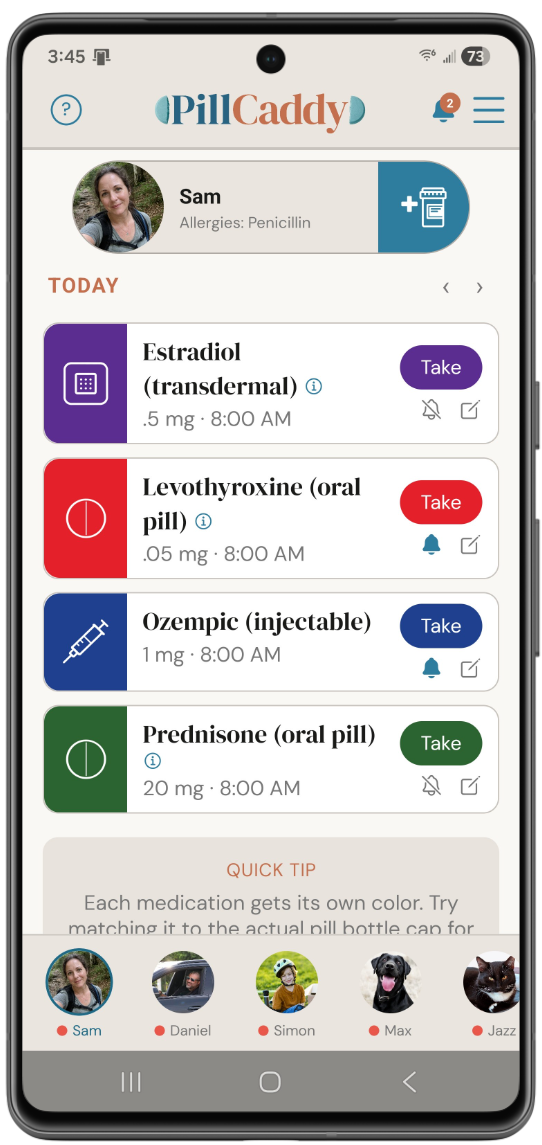
A medication tracking app designed for shared use is what PillCaddy does. Every household member with permission can mark a dose as administered, and everyone else immediately sees it. The medication list, schedule, and history all live in one place. The texting-back-and-forth that eats up coordination energy goes away because the answer to "did Mom take her morning pills?" is always visible to anyone who looks at the app. The free Essentials tier covers households with up to two members; the Plus tier expands to more members for families with multiple siblings, in-laws, or aides who are all part of the care circle. We'll be honest about our bias here: we built PillCaddy specifically for this problem, because the existing options didn't solve it. But the principle is more important than the tool: whatever you use, it has to be shared, real-time, and trusted by everyone.
Pharmacy blister packs are a structural simplification that pairs well with any of the above. Most pharmacies will pre-sort medications into weekly or monthly blister packs where each dose is sealed in its own labeled compartment. For caregivers administering medications, blister packs eliminate the sorting work and provide immediate visual confirmation. Ask your parent's pharmacist what services they offer for caregivers.
The right combination depends on your family's situation. Most multi-caregiver families end up using a layered approach: pharmacy blister packs for the physical structure, a shared app for the real-time log, and family group communication for the bigger updates.
Roles worth assigning explicitly
Beyond the primary medication manager, several other roles tend to emerge in multi-caregiver families. Naming them explicitly helps everyone know who to ask when a question comes up.
The daily administrator. Whoever is physically present at scheduled medication times. This may rotate between family members, or it may be one person most of the time with backup for emergencies. The daily administrator's job is to give the dose, log it, and flag anything unusual.
The medical liaison. The person who attends doctor's appointments, communicates with the prescribing physician, and is the family's authoritative source for "what did the doctor actually say?" This is often the same person as the primary medication manager but not always.
The pharmacy contact. The person who handles refills, coordinates with the pharmacist, troubleshoots insurance issues, and is the named contact at the pharmacy. Having one named family contact at the pharmacy prevents the confusion of multiple calls about the same patient, and pharmacists are better able to stay current on the picture when they're working with a single consistent person.
The long-distance coordinator. A role specifically designed for family members who can't be physically present. They handle insurance paperwork, schedule appointments, coordinate refills, manage the medication list document, and provide backup decision-making. Long-distance family members who feel guilty about not doing daily work often find this role meaningful, because it removes real burden from the on-site caregivers.
The relief caregiver. The person who steps in when the primary daily administrator needs a break, gets sick, or has a personal crisis. Every multi-caregiver family needs at least one relief caregiver, and the relief caregiver needs to know enough about the system to step in without disruption. Pre-briefing the relief caregiver on the medication routine, before they're needed in a pinch, prevents emergencies from becoming bigger emergencies.
Not every family needs all of these as separate people. Many families have one person doing several roles. The point isn't to multiply the org chart; it's to make sure none of these functions is silently falling through the cracks.
When a professional aide is part of the care circle
Home health aides, certified nursing assistants, and other paid caregivers introduce specific considerations.
The medication record system has to include the aide. If the family is using a shared app, the aide needs access and training. If the family is using a paper logbook, the aide needs to know to use it. Excluding the aide from the system means a critical part of the care is happening invisibly to the family.
The scope of what the aide is allowed to do varies by certification and by state. Some aides can administer medications; some can only remind the patient and observe. Know what your aide's specific scope is, in writing, and don't ask them to work outside it; both because it's not their job and because doing so creates legal liability for them.
Treat the aide as a colleague, not a service. The best multi-caregiver arrangements treat the aide as a peer in the care circle, brief them thoroughly on what they need to know, and listen to their observations about the patient. Aides see things family members don't, and dismissing their input means missing important signals.
Pre-brief every new aide. When a new aide joins the team, walk them through the medication system in detail before they handle any doses. Don't assume general nursing experience translates into knowledge of your specific parent's routine.
When siblings disagree
Most of this article assumes the family is working together in good faith. Many multi-caregiver situations are like this. Some aren't. Sibling disagreements about a parent's care are some of the hardest interpersonal situations adult life produces, and medication management can become a flashpoint for conflicts that are really about something else.
A few patterns worth recognizing:
Disagreement about whether the parent needs help at all. One sibling sees the decline clearly; another minimizes it, often because they live far away and only see the parent on good days. This is one of the most common multi-caregiver conflicts. The fix is usually documentation: a shared log that shows the actual pattern of missed doses, confused episodes, or other concrete events makes the situation harder to minimize.
Disagreement about how much to do. One sibling wants to add more medications, more support, more interventions; another wants to leave well enough alone. This often reflects different relationships with the parent and different anxieties about decline. There's rarely a single right answer here. What works is keeping the conversation focused on what the parent themselves wants, and accepting that adult children can disagree about parental care without anyone being wrong.
Unequal burden producing unequal voice. The sibling doing the daily work often feels their opinion should carry more weight; the distant sibling sometimes asserts authority despite not being present. Both reactions are understandable and both can damage the family. The honest principle: daily presence matters, but it doesn't grant unilateral decision authority. Distance siblings have a stake too. Find the balance where the on-site caregiver's voice is heavily weighted but not dominant.
Old family dynamics resurfacing. Caregiving for an aging parent has a way of pulling forward every unresolved family pattern from earlier life. The favored child, the responsible child, the absent child: the roles often reassert themselves in caregiving, sometimes painfully. Therapists who specialize in family caregiving can be enormously helpful here, and the Family Caregiver Alliance maintains directories of support resources for families navigating these dynamics.
If conflict is making the medication management dangerous (doses being missed because nobody is talking to anyone), professional mediation is sometimes the right move. A geriatric care manager can sometimes serve as a neutral third party who helps the family come to workable arrangements.
A closing word
The medication management piece is, in most multi-caregiver families, just one part of a much larger care picture. The same family that's coordinating medications is probably also coordinating doctor's appointments, financial management, household maintenance, social engagement, and eventually end-of-life planning. The medication system is often the first piece families try to systematize, because it's concrete and the failure modes are obvious. The lessons learned there usually carry over to the rest of the care work.
A few things worth saying if you're in this situation right now:
The fact that you're trying to coordinate this well is itself meaningful. Many families don't, and the consequences land on the parent and on the relationships. Putting energy into the systems is an act of care, not just for your parent but for the family that will need to keep working together for a long time.
Disagreements are normal, and good families have them. The goal isn't to avoid conflict; it's to handle it in ways that don't damage the underlying relationships. Apologize when you're wrong, hold your ground when you're right, and remember that everyone involved usually loves the parent.
You don't have to figure this out alone. Beyond the family, professional support exists: care managers, social workers at hospitals and senior centers, your parent's primary care team, support groups for adult children caring for parents. Most multi-caregiver families benefit from outside help at some point.
And whatever happens with the medications and the coordination and the systems, the underlying thing your family is doing is one of the hardest and most important kinds of work adult life produces. There's no version of this that will feel clean or finished or easy. There are versions that work well enough, where the parent is cared for and the family is intact. That's the goal. Most days, it's enough.

The shared log your care circle needs
PillCaddy is the shared medication record this article describes. Anyone in the care circle can log a dose, see what's been given, and check what's still due, all in real time. Essentials is free; Plus covers households with siblings, aides, and multiple caregivers.
Frequently asked questions
Why is coordinating a parent's medications among several people so hard?
When more than one person is involved, three specific problems appear: duplicate doses when two people each give the same medication, dropped doses when everyone assumes someone else handled it, and the constant texting and calling to stay aligned. They all trace back to the same root cause, which is the lack of a shared source of truth everyone trusts. Solving that one thing resolves most of the rest.
How should my siblings and I divide up medication responsibilities?
Be specific rather than vague about who does what. Naming concrete roles, such as one person owning the medication list and pharmacy relationship while another handles daily doses on their visit days, works far better than everyone helping with everything. Assigning clear roles is also what most caregiver guidance recommends.
What does a primary medication manager do?
The primary medication manager owns the overall picture: the current list, the schedule, the relationship with the doctor and pharmacist, and the decision-making authority when something changes. Other caregivers administer doses and check the shared record, but one person keeps the system coherent. Without this role, every change needs a slow group decision.
How can a long-distance sibling actually help with medications?
Plenty of meaningful work does not require being physically present, including insurance navigation, pharmacy coordination, scheduling appointments, and maintaining the medication list. A long-distance coordinator role removes real burden from the on-site caregivers. It often helps distant family members feel genuinely useful rather than guilty.
Should a home health aide be included in our medication system?
Yes. If the aide is part of the care, they need to be part of whatever record the family uses, whether that is an app or a paper log, or a critical piece of the care happens invisibly. Know the aide's specific scope in writing, since what they are permitted to do varies by certification and state, and do not ask them to work outside it.
What if my siblings and I disagree about our parent's care?
Disagreement is common and often reflects different relationships with the parent or different proximity to the daily reality. A shared log that documents the actual pattern of doses and events can ground the conversation in facts rather than impressions. When conflict starts making the medication management unsafe, a geriatric care manager or mediator can help.
What is the minimum a shared medication system needs to do?
It should show the current medication list, track what was given today and by whom, surface what is still due, hold a history for the doctor to review, and be accessible to everyone involved, including long-distance family and any aide. A shared app does this well, and pharmacy blister packs pair nicely with it for physical structure. The key requirement is that it is shared, current, and trusted by everyone.