
Managing medications for an aging parent is one of the most demanding parts of caregiving. It starts simply enough: a blood pressure medication here, a cholesterol pill there. Then comes a diagnosis, a new specialist, a second opinion, and before long you are looking at eight or ten prescriptions with different schedules, different requirements, and different consequences if they are missed or doubled up.
This is not an unusual situation. Many older adults take five or more medications daily. The complexity is real, and the stakes are high. Here is a practical guide to getting it under control.
Understand the full picture first
Before you can organize anything, you need a complete list of everything your parent is taking. This means prescriptions from every doctor, but also over-the-counter medications, vitamins, and supplements. Many drug interactions involve things people do not think of as medications at all.
Sit down with your parent and go through everything in the medicine cabinet. Write down the name, dose, prescribing doctor, and what condition it is for. If possible, bring this list to the next appointment with their primary care physician and ask for a medication review. Polypharmacy (taking many medications at once) is a known problem in older adults, and a good doctor will appreciate the chance to evaluate whether everything on the list is still necessary.
The coordination problem
Here is where medication management for seniors becomes genuinely difficult: most of the time, more than one person is involved. Maybe you and your sibling share caregiving responsibilities. Maybe your parent has a home health aide during the day and a partner at home in the evenings. Maybe they are mostly independent but you check in a few times a week.
When multiple people are involved, gaps appear. Someone gives a dose and forgets to tell anyone. Someone else comes by and gives it again. Or nobody gave it because everyone assumed someone else had. Neither outcome is acceptable with medications that require consistent dosing.
The fix is a shared system that everyone can see in real time. A paper chart on the refrigerator is better than nothing, but it only works if everyone is physically present to check it and update it. A shared digital log is far more effective. The same coordination problem shows up whenever more than one person shares caregiving duties, including tracking children's fever medicine across two parents through a long night or multiple adult children sharing a parent's daily care.
What to look for in a tracking system
Not every medication app is built for caregiving situations. Here is what actually matters:
Shared access. The system needs to be visible to everyone involved in your parent's care, not just one person. If a dose gets logged, every caregiver should be able to see it immediately.
Simple logging. If logging a dose takes more than a few taps, it will not happen consistently. The whole system falls apart if it is too much friction to use in the moment.
Reminders that travel with the caregiver. A reminder that only goes to your parent's phone is not enough if they do not always have their phone nearby, or if their memory is unreliable. Caregivers need reminders too. For a full comparison of which reminder system fits which stage of a parent's needs, medication reminders for the elderly covers the full category landscape.
Support for complex schedules. Seniors often take medications that are not simple "once a day" pills. Weekly injections, medications taken with food, tapering doses after surgery, medications taken every other day. The system needs to handle these without workarounds.
Supply tracking. Running out of a critical medication is a preventable crisis. A system that tracks how many doses remain and reminds you to refill is worth its weight.
Common mistakes to avoid
Relying on memory. Even people with excellent memories make mistakes when schedules are complex and the days run together. Write everything down, always.
Consolidating without asking the doctor. It is tempting to move all medications to once-a-day dosing for simplicity. Always check with the prescribing doctor before changing the timing of a medication. Some drugs require specific timing for safety or effectiveness reasons.
Assuming the patient is tracking it themselves. Cognitive decline can be gradual. Your parent may not be aware that their recall is slipping. If dementia is part of the picture, managing medications for someone with dementia introduces specific challenges that go beyond the basics here. An external system is not an insult; it is good caregiving.
Not updating the list. Medications change. Dosages change. New prescriptions get added, old ones get discontinued. Treat your medication list as a living document and review it at every doctor's appointment.
A shared approach makes the difference
If you are coordinating care with siblings or other family members, getting everyone onto the same system is the most important step you can take. The goal is a single source of truth that anyone involved in your parent's care can check, update, and trust.
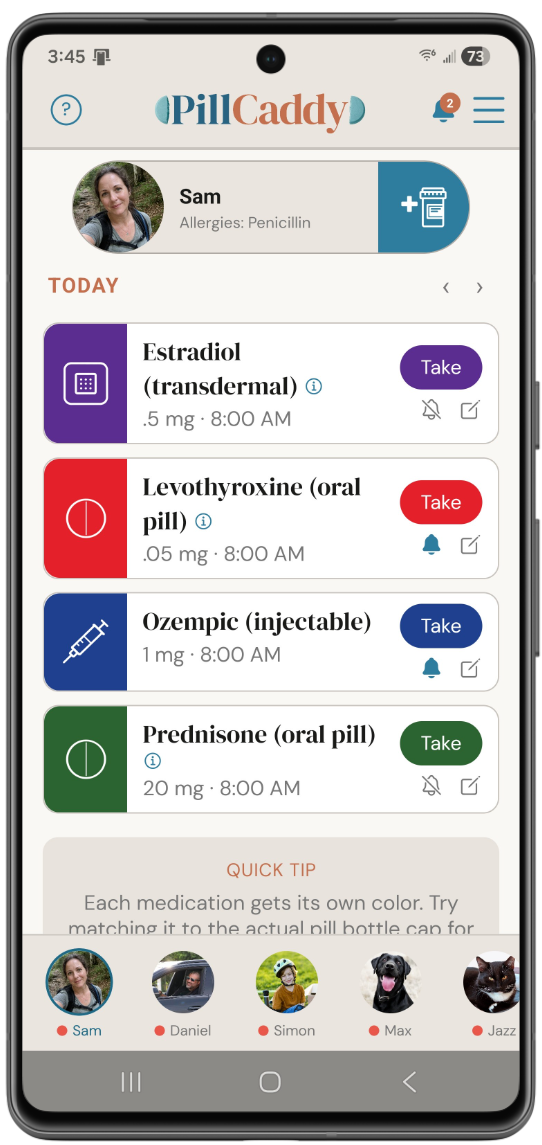
Apps like PillCaddy are built specifically for this kind of household caregiving situation. You can add your parent as a member, set up all their medications with the correct schedules, and share access with every caregiver involved. When someone logs a dose, everyone sees it. When a refill is coming up, the right people get reminded.
Good medication management for seniors is not about technology. It is about reducing the chances that something slips through the cracks. Whatever system you use, the most important thing is that everyone uses the same one.

The whole care circle, on the same page
PillCaddy lets you add your parent, set up their full medication schedule, and share real-time access with every caregiver involved. When one person logs a dose, everyone else sees it immediately. Essentials is free; Plus expands to larger care circles.
Frequently asked questions
How do I start organizing my elderly parent's medications?
Begin by building one complete list of everything they take, including prescriptions, over-the-counter products, vitamins, and supplements, with the dose, prescribing doctor, and reason for each. Going through the medicine cabinet together is the most reliable way to capture the full picture. Once you have that list, you can bring it to their next appointment for a review.
What should a senior medication list include?
A useful list captures the medication name, the dose, the schedule, the prescribing doctor, and the condition it treats. Keeping over-the-counter products and supplements on the same list matters because they can interact with prescriptions. Treat it as a living document and update it whenever anything changes.
How can my siblings and I avoid giving our parent a double dose?
The usual cause of double dosing is that no one has a shared, real-time record of what was already given. A system everyone can check before administering a dose closes that gap, whether it is a shared app or a log everyone keeps current. PillCaddy is built for this kind of shared visibility, so any caregiver can confirm the status before acting.
Is it safe to switch all my parent's medications to once a day to make it simpler?
That is a decision for the prescribing doctor or pharmacist, not something to change on your own. Some medications need specific timing for safety or effectiveness reasons. Ask at the next appointment whether the schedule can be simplified, and let the clinician make the call.
What features actually matter in a medication app for caregivers?
The ones that matter most are shared access so every caregiver sees the same record, simple logging that takes only a few taps, reminders that reach caregivers and not only the patient, support for complex schedules, and supply tracking so refills do not sneak up on you. An app built for a single user rarely covers a whole household well.
My parent says they are managing fine. How do I know if they need help?
Cognitive decline can be gradual, and a parent may not notice their own recall slipping. Watch for full or skipped compartments in a pill organizer, uncertainty about whether a dose was taken, or missed refills. If you have concerns, raising them with their doctor is a sensible next step.
What is polypharmacy and why does it matter for seniors?
Polypharmacy means taking several medications at once, which is common in older adults and raises the chance of interactions and confusion. A periodic medication review with the prescribing doctor or pharmacist can check whether everything on the list is still needed. Keeping an accurate, current list makes that review far easier.