
If your dog is on medication, you already know that it is more complicated than it sounds. Dogs do not take pills voluntarily. Schedules vary. And if you share a home with someone else who also helps with your dog's care, the question of "did someone already give Luna her pill?" comes up more often than you would like.
Here is a practical guide to managing your dog's medication schedule without losing track.
Why dog medication tracking is harder than it looks
With a simple daily medication like a heartworm preventative, the schedule is easy enough to remember. But as soon as you move into actual treatment, things get more complex: antibiotics for an infection, anti-inflammatory medications after surgery, phenobarbital for seizures, thyroid medication twice a day.
The core problem is that medications have consequences in both directions. A missed dose of a seizure medication can trigger an episode. A doubled dose of certain drugs can cause serious harm. With a pet who cannot tell you whether they already had their medication, the margin for error feels uncomfortably small.
Add another person to the equation, a roommate, a partner, a family member who walks the dog while you are at work, and the chances of a mix-up increase. Not because anyone is careless. Simply because neither person has a reliable way to know what the other did.
The coordination problem
This is the scenario that catches most pet owners off guard. You give your dog his evening medication before you go to bed. Your partner, who got home late and did not want to wake you, gives it again an hour later because they were not sure it had been done.
Or the opposite: you both assume the other person handled the morning dose, and your dog goes the whole day without it.
Neither of these situations is a failure of caring. They are a failure of coordination. The solution is not to try harder to remember. It is to have a shared system so that both people always know the current state of the medication, in real time, without having to ask.
Managing complex dog medication schedules
Simple medications are manageable. The harder cases are where most pet owners struggle.
Seizure medications like phenobarbital or potassium bromide typically need to be given at the same time every day, consistently. Even a few hours off schedule can affect blood levels and seizure control. These medications also require regular blood monitoring, which means keeping track of when the last level was checked.
Post-surgery medications often involve multiple drugs on overlapping schedules: a pain medication every eight hours, an antibiotic twice a day, and a steroid tapering from twice a day down to once a day over two weeks. Keeping that straight in your head while also caring for a recovering dog is a lot.
Thyroid medication needs to be given at a consistent time relative to meals for accurate absorption. Get this wrong consistently and the dosing adjustment your vet makes at the next visit will be based on inaccurate information.
Antibiotics need to be completed in full, even when your dog seems completely better after a few days. The temptation to stop early is real, and a tracking system makes it easier to see exactly how many doses are left.
Heartworm prevention and other recurring preventatives are a different kind of tracking problem. A monthly preventative like Heartgard does not feel urgent the way a daily medication does, which is exactly why it is so easy to lose track of. You give it, life moves on, and three weeks later you cannot remember whether it was this month or last month that you gave it. Miss a month and your dog has a gap in coverage. Miss two and you may be looking at a heartworm test before your vet will refill the prescription.
Some preventatives stretch even longer. ProHeart 12 is a heartworm injection given once a year by a veterinarian. Bravecto, a popular flea and tick preventative, protects for three months per dose. Rabies boosters are required every one to three years depending on the vaccine and your local laws. The annual DHPP vaccine covers distemper, parvovirus, and a handful of other serious diseases. Most dog owners rely entirely on a reminder postcard from their vet to stay on top of these. If the postcard does not arrive, or you move, or your vet changes their system, it is surprisingly easy to be months overdue without knowing it.
The answer is the same as it is for daily medications: write it down in a system that will remind you. A note in your phone's calendar is better than nothing. An app that tracks the schedule and sends you a reminder a week before the next dose is better still.
What actually helps
A written log works, but only if everyone uses it. A notepad on the counter is better than nothing, but it falls apart when someone is in a hurry, when the notepad gets moved, or when someone is not physically at home.
The most reliable solution is a shared digital log that everyone involved in your dog's care can access from their phone. When someone gives a medication, they log it immediately. The other person can check the app before giving anything and see exactly what has been done and when.
This removes the ambiguity entirely. You do not have to call or text to ask. You do not have to guess. You just open the app.
A system built for pets too
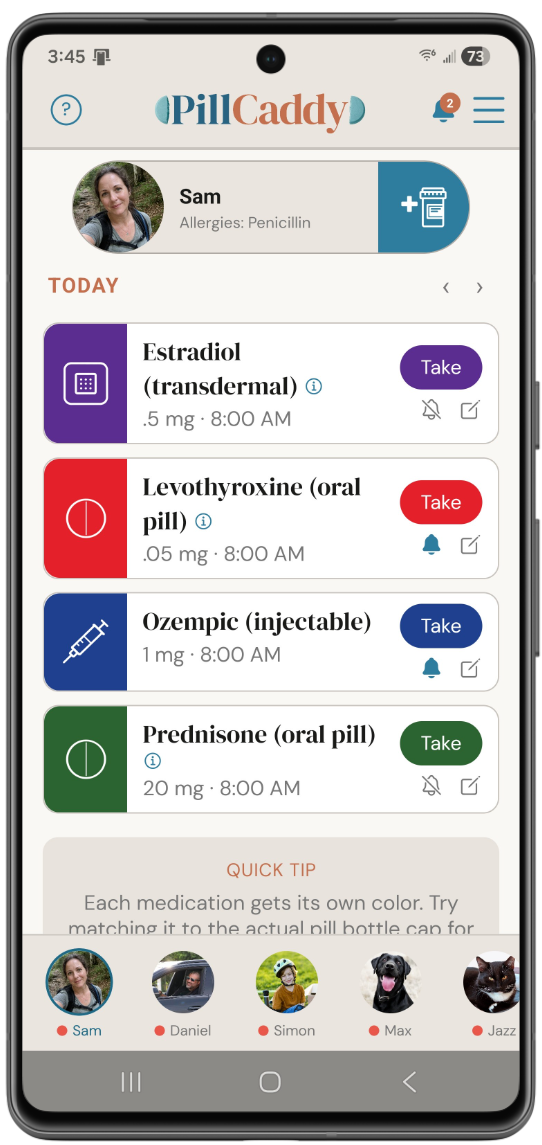
PillCaddy treats pets as full household members, not an afterthought. You can add your dog, set up all their medications with the correct schedules (once a day, twice a day, every eight hours, tapering doses), and share access with everyone who helps with their care.
When one person logs a dose, the other person sees it immediately. Reminders go to both of you. And if you are tracking a medication with a limited supply, PillCaddy can remind you when it is time to refill.
For dogs on long-term medications, or any pet going through a treatment course that requires consistent timing, having a shared real-time log is one of the simplest and most effective things you can do. It removes the coordination problem entirely and lets both of you focus on what actually matters: taking care of your dog. The same approach works just as well for cats on twice-daily thyroid medication or monthly preventatives, or for tracking children's fever medicine across two parents on a long night.

Everyone who helps can see the log
PillCaddy treats your dog as a full household member. Add their medications, from daily pills to monthly preventatives, share access with anyone who helps with their care, and give everyone the same real-time log. The Essentials tier is free.
Frequently asked questions
How do I keep track of my dog's medication schedule?
Write it down in a system that will remind you rather than relying on memory, especially once you move beyond a single daily pill into treatment courses. A shared digital log works well because anyone who helps with your dog's care can check it and update it from their phone. PillCaddy treats your dog as a full household member, so every medication and schedule lives in one place.
My partner and I keep double dosing or missing our dog's pills. How do we fix it?
This is a coordination problem rather than a memory problem, and the fix is a shared record both of you can see in real time. When one person gives a dose and logs it immediately, the other can check before giving anything. That removes the guesswork without anyone having to call or text.
How do I remember monthly preventatives like heartworm or flea medication?
Recurring preventatives are easy to lose track of precisely because they do not feel urgent day to day. A system that stores the schedule and reminds you ahead of the next dose is more reliable than a postcard from the vet. PillCaddy can remind you when a recurring dose is coming up.
What is the best way to manage my dog's medications after surgery?
Post-surgery care often involves several medications on overlapping schedules, which is a lot to hold in your head while caring for a recovering dog. A written or shared log that lists each medication and its timing keeps everything straight. For the specifics of the regimen itself, follow the instructions from your veterinarian.
Should I stop my dog's antibiotics once they seem better?
That is a decision for your veterinarian, not something to judge by how your dog looks. A tracking system helps by showing exactly how many doses remain so you can see the course through as it was prescribed. If you have questions about the course, ask your vet.
Can one app track medications for both my dog and the rest of my household?
Yes. PillCaddy treats pets as full household members alongside people, so your dog's medications sit in the same shared system as everyone else's. Anyone who helps with care can see the log and the reminders. That is especially useful when more than one person looks after the dog.